The Complete Picture: Curating a Bridal Jewelry Suite That Feels Unified, Personal, and Utterly Yours
Photo: AnonymousUnknown author, Public domain, via Wikimedia Commons
There is a particular kind of stillness that settles over a bride on her wedding morning. The dress is hanging. The flowers have arrived. And somewhere on the vanity sits a jewelry box — one that holds not just a ring, but an entire language of adornment she has spent months carefully choosing. That box, and everything inside it, represents decisions made with intention. Getting to that moment of quiet confidence requires more than selecting beautiful individual pieces. It requires a strategy.
Bridal jewelry is often discussed as though it begins and ends with the engagement ring. In reality, the ring is merely the opening line of a much longer story. The earrings, the necklace, the bracelet, the hairpins — each of these elements participates in a visual and emotional conversation that unfolds across your wedding day. When those pieces are chosen thoughtfully, in relation to one another and to the dress, the result is something that transcends individual beauty. It becomes a complete portrait.
Begin With the Dress, Not the Display Case
The most common mistake brides make when assembling their jewelry is beginning at the jeweler before they have a clear picture of the gown. Your dress is the foundation upon which everything else is built, and its neckline, silhouette, and embellishment level will guide nearly every jewelry decision that follows.
A deeply plunging V-neck, for instance, creates a natural corridor for a delicate pendant necklace or a simple chain with a single stone. Pairing that same neckline with a dramatic collar necklace creates visual competition rather than harmony. A strapless ballgown, by contrast, opens the décolletage entirely and invites a bolder statement — a refined choker, a graduated strand of pearls, or a layered fine chain set that draws the eye upward.
Highly embellished gowns — those with intricate beading, lace appliqué, or dramatic texture — generally call for restraint in jewelry. In these cases, the dress is the statement, and your jewelry serves as a quiet complement. Simpler silhouettes, on the other hand, welcome pieces with more presence.
The Art of the Anchor Piece
Every bridal jewelry suite benefits from what designers often call an anchor piece — the single most prominent item around which all other selections are organized. For some brides, the engagement ring naturally assumes this role, and the remaining pieces are chosen to echo its metal tone, stone shape, or design vocabulary. For others, a pair of heirloom earrings inherited from a grandmother serves as the emotional and aesthetic center of gravity.
Identifying your anchor piece early simplifies every subsequent decision. If your engagement ring features a cushion-cut diamond in a yellow gold setting, you are already working with a warm, vintage-leaning aesthetic. Earrings in rose-cut diamonds or champagne sapphires, a delicate yellow gold bangle, and subtle hair pins in the same metal family will create a suite that feels curated rather than assembled. Nothing competes. Everything contributes.
Earrings: The Frame Around Your Face
Of all the pieces a bride wears on her wedding day, earrings are often the most photographed. They appear in every close portrait, in candid moments, and in the intimate photographs taken during the getting-ready hours. Their importance, therefore, cannot be overstated.
Hairstyle plays a decisive role here. An updo or a chignon exposes the ears entirely, making earrings the most visible jewelry on your face. Long, dramatic drops or chandelier styles can be extraordinarily beautiful in this context, provided they do not overpower the face or compete with other statement pieces. A half-up style allows for slightly more flexibility — earrings of moderate length work well, as do elegant studs with meaningful stones.
For brides wearing their hair down, earrings may be partially obscured, which makes the case for either a truly striking piece that will be glimpsed rather than fully seen, or a refined stud that holds its own without demanding constant visibility.
Necklace or No Necklace: Making the Honest Choice
Not every bride needs a necklace. This is a truth that the jewelry industry occasionally obscures, but it bears stating plainly. If your dress has a high neckline, a heavily embellished bodice, or a halter silhouette, a necklace may simply add visual noise to an already complete picture.
When a necklace is appropriate, the length matters enormously. A princess-length strand (typically 17 to 19 inches) sits just below the collarbone and works well with most necklines. A matinee length (20 to 24 inches) falls between the collarbone and bust and suits lower necklines beautifully. Chokers, currently experiencing a refined revival in bridal styling, pair particularly well with strapless and off-the-shoulder gowns.
If you choose not to wear a necklace, consider whether a more elaborate earring or a hair accessory might serve as the visual focal point your overall look requires.
The Bracelet: A Detail That Photographs With Grace
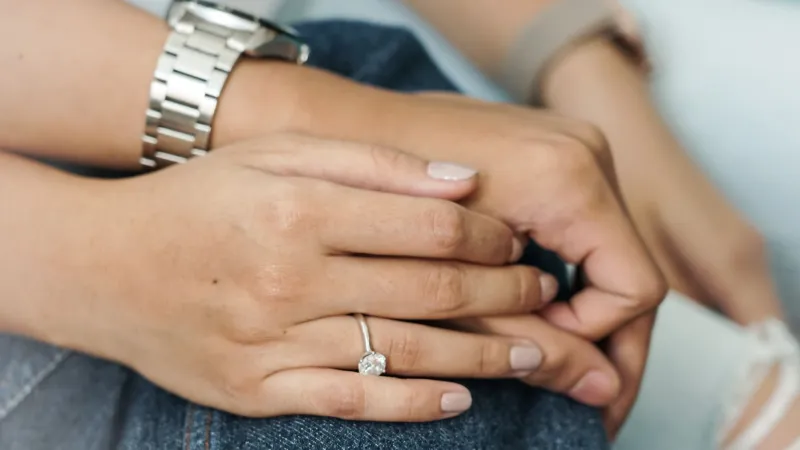
The bridal bracelet is perhaps the most underappreciated element of the suite. It appears in bouquet shots, in the moment the ring is placed on your finger, and in every image where your hands are visible. A single fine tennis bracelet, a delicate bangle, or a strand of pearls adds dimension to the wrist without demanding attention.
If you are wearing a watch — and many brides choose to for practical reasons — consider whether it belongs in the jewelry conversation or whether it might be set aside for the day in favor of something more intentional. A timepiece can be beautiful, but it rarely speaks the same language as fine bridal jewelry.
Hair Accessories: The Finishing Sentence
Hair accessories — pins, combs, vines, and headbands — complete the suite in a way that is often felt more than seen. A scattering of pearl-tipped pins through a loose updo creates a softness that registers in photographs and in person without announcing itself loudly. A delicate diamond-set comb worn at the crown adds formality without weight.
When selecting hair accessories, return to your anchor piece and ask whether the metals and stone shapes are consistent. A bride wearing white gold and round diamonds throughout her suite will find that silver-toned, round-set hair pins feel like a natural extension of her look. Mixing metals intentionally can be beautiful, but mixing them accidentally creates a subtle visual dissonance that is difficult to identify but easy to feel.
Assembling the Suite: A Final Word
The most elegant bridal jewelry suites are not necessarily the most expensive. They are the most considered. They reflect a bride who understood her dress, honored her personal aesthetic, and made choices that spoke to one another across every piece. They are suites built around an anchor, edited with restraint, and completed with details that feel quietly personal.
At Sonia Jewellery & Bridal, we believe that the jewelry box a bride opens on her wedding morning should hold no surprises — only the deep, settled satisfaction of knowing that every piece inside was chosen with care. That is the kind of completeness that belongs to a legacy.