What You Already Own: Building Your Bridal Suite From the Jewelry That Has Always Mattered
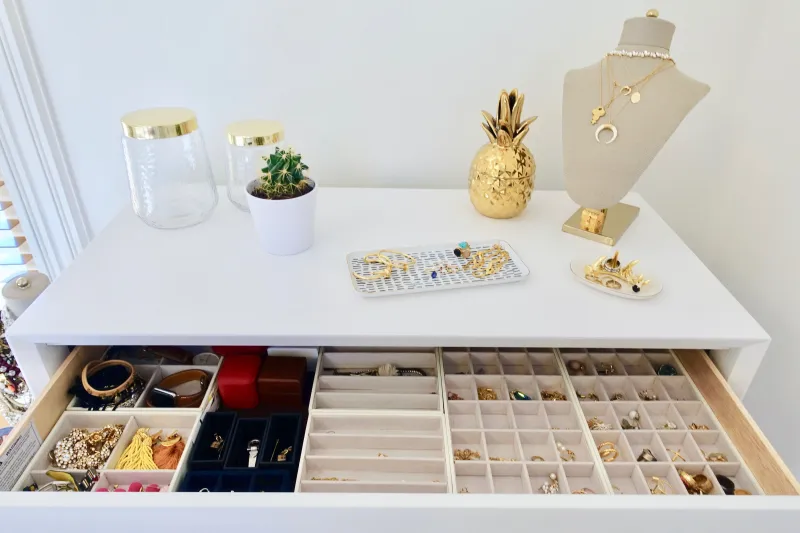
Photo: woman organizing jewelry collection heirlooms on white surface engagement, via i.pinimg.com
There is a particular kind of quiet that settles over a jewelry drawer when you open it with new eyes. What was once a collection of accumulated moments—a grandmother's brooch, a bracelet purchased on a solo trip abroad, a ring that once carried a different kind of meaning—becomes something else entirely when you are newly engaged. It becomes material. Not in the superficial sense, but in the truest one: the raw matter from which a bridal story can be built.
Many couples arrive at the jewelry design process assuming they must begin from nothing. They open catalogs, scroll through inspiration boards, and schedule consultations as though their personal histories are irrelevant to what they are building now. But at Sonia Jewellery & Bridal, we have seen again and again that the most resonant bridal suites are rarely assembled from scratch. They are curated from a life already lived—and then extended with intention.
If you own meaningful jewelry, the question is not whether it belongs in your bridal story. The question is how.
Start With a Genuine Inventory
Before any design conversation can happen, you need to know precisely what you are working with. This means more than glancing at what you own. It means removing every piece from its usual resting place, laying it on a clean surface in good light, and looking at it as though for the first time.
For each piece, ask yourself three questions: Where did this come from? What does it mean to me now? And—perhaps most importantly—does the emotion it carries feel like something I want present on my wedding day?
Not everything that is meaningful needs to be visible. Some pieces carry complicated histories: a ring from a previous relationship, a gift from someone who is no longer in your life in the same way, or an heirloom from a family member whose memory is layered with complexity. Meaningful and appropriate are not always synonymous. Give yourself permission to make that distinction honestly.
Separate the Pieces Into Three Categories
Once you have completed your audit, a useful framework is to divide what you own into three working groups.
Pieces that belong as they are. These are items that require no alteration, no redesign, and no explanation. They are beautiful, they are wearable, and they carry the kind of emotional weight that makes them natural inclusions in your bridal ensemble. A grandmother's pearl earrings, for instance, may need nothing more than a professional cleaning and a place in your ceremony-day plan.
Pieces that hold meaning but need transformation. These are the candidates for custom redesign—stones reset into new settings, metals melted down and recast, or multiple pieces combined into a single cohesive design. A ring that belonged to a relative, for example, may carry exactly the legacy you want to honor, but its style may feel misaligned with who you are today. Transformation is not erasure. It is continuation.
Pieces that belong in the archive, not on the day. Some jewelry is deeply meaningful without being appropriate for your wedding. Perhaps a piece is too fragile for the event, too emotionally complicated, or simply not reflective of the aesthetic you are building. These pieces deserve respect—but they do not need to appear on your wrist or at your neckline to matter. Document them. Photograph them. Store them with their stories intact.
Thinking About Cohesion Without Uniformity
One of the most common concerns couples raise when integrating existing jewelry into a bridal suite is the question of visual cohesion. If your engagement ring is modern platinum and your grandmother's bracelet is yellow gold filigree, do they belong in the same ensemble?
The short answer is that cohesion does not require uniformity. What makes a bridal suite feel intentional is not that every piece was purchased from the same collection in the same metal—it is that every piece has a reason for being there. When you can speak to the significance of each item you are wearing, the visual differences become part of the narrative rather than a disruption of it.
That said, there are design strategies that help disparate pieces feel related. Repeating a motif—a floral element, a particular stone, a specific texture—across new and existing pieces creates visual dialogue without demanding that everything match. Your jeweler can help you identify these threads and carry them forward into any new pieces you commission.
The Role of the Custom Consultation
If you are considering transforming existing pieces, a custom design consultation is not a luxury—it is a necessity. A skilled jeweler will evaluate the structural integrity of stones and settings, advise on which metals can be successfully melted and reformed, and help you articulate a design vision that honors the source material while creating something genuinely new.
Bring photographs of pieces you cannot physically bring to the appointment. Bring documentation of provenance if you have it. And bring your own words: describe what the piece means to you, what era of your life it represents, and what you want the finished design to feel like when you wear it on your wedding day.
The conversation between a couple and their jeweler at this stage is one of the most intimate in the entire bridal process. It asks you to speak honestly about your history, your aesthetic, and your intentions—and then trust a craftsperson to translate all of that into something enduring.
Honoring History Without Being Held by It
There is a version of this process that becomes paralyzing. Couples sometimes feel so obligated to incorporate every meaningful piece—so reluctant to set anything aside—that the resulting suite feels crowded rather than curated. The goal is not to wear your entire history simultaneously. It is to choose the threads of that history that feel most alive to who you are becoming together.
Your bridal jewelry is not a museum exhibition. It is a living expression of a love story that is still being written. Some chapters of your past belong prominently in that story. Others belong in the footnotes—honored, preserved, but not foregrounded.
The jewelry drawer audit, done with genuine honesty and care, helps you make those distinctions. And when you arrive at your wedding day wearing pieces that span generations, relationships, and eras of your own becoming, you will understand why this process was worth every careful conversation it required.